CSANZ Code of Conduct

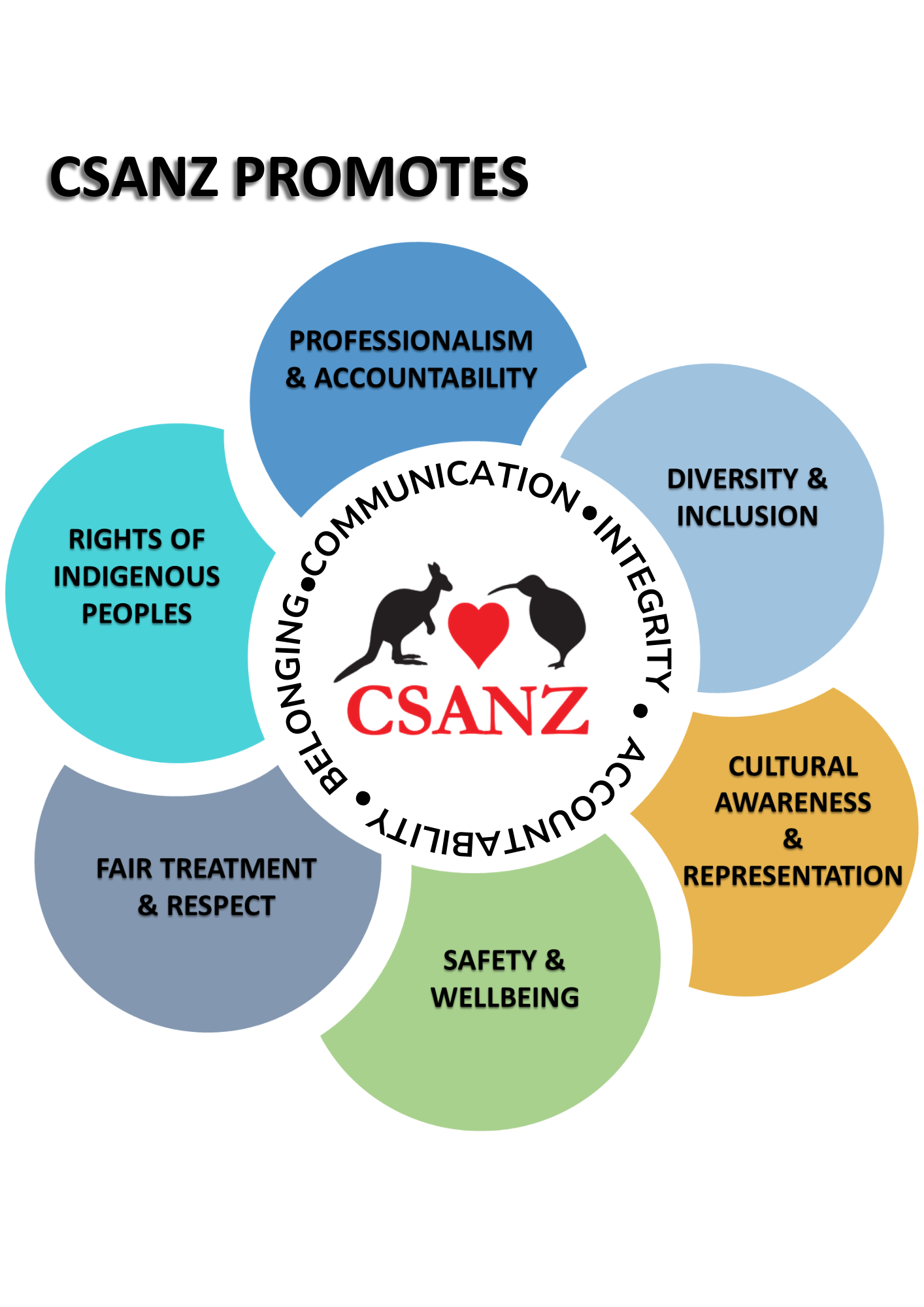
This CSANZ Code of Conduct is founded on the fundamental expectation of respect for others, and has been established to support all Members working together to create a safe, inclusive, and engaging work environment. Creating a respectful and inclusive culture not only establishes a platform for greater engagement, but also one that attracts new Members to both the Society and our professional fields.

Respect is established and recognised as affirmed by the United Nations Declaration on the Rights of Indigenous Peoples (UNDRIP), of which both Australia and New Zealand are signatories.

This Code of Conduct outlines the principles and expectations for professional behaviour, integrity, and collaboration within our organisation.
View the CSANZ Code of Conduct here

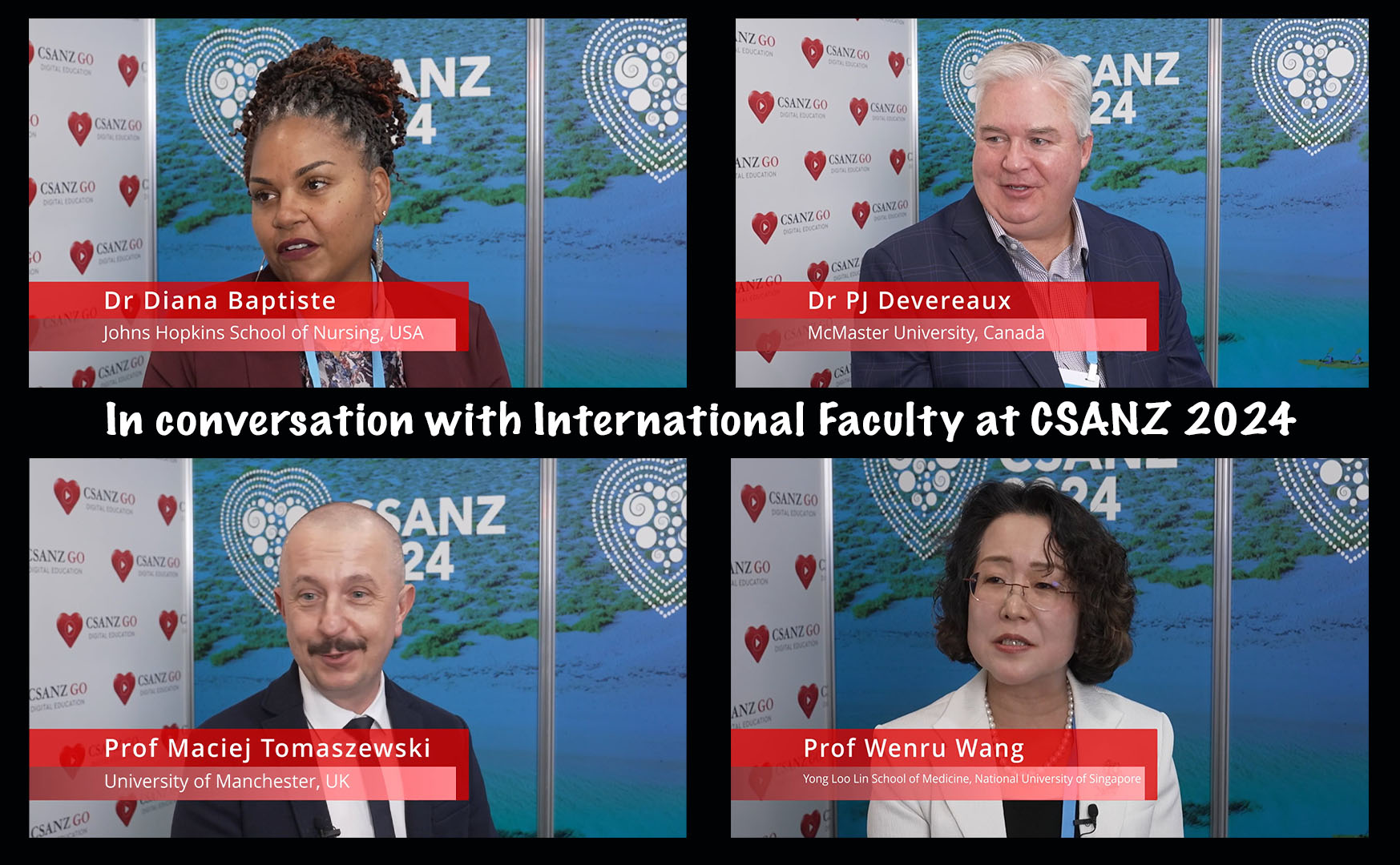
In conversation with International Faculty at CSANZ 2024

In Conversation with invited International Faculty 2024 CSANZ ASM: 

  • Dr Diana Baptiste, Johns Hopkins School of Nursing, USA. Discusses her work on promoting health equity and disparities across the US, and how much she learnt from Australian and New Zealand presenters that face similar issues, plus she tells of her highlights of being part of the 2024 CSANZ ASM.
  • Dr Devereaux, McMaster University, Canada spoke at the Joint CSANZ Clinical Trials Council / ANZACT Symposium, as well as presenting in our Clinical and Surgical stream throughout the ASM. Namely, “Perioperative cardiovascular care: State of the art” and “The need for new diagnostic criteria for myocardial injury / infarction after cardiac surgery”.
  • Prof Maciej Tomaszewski, University of Manchester talks about his presentations on “Genetic imputation of kidney transcriptome and proteome providing new insights into blood pressure regulation and human hypertension” and “Biological therapeutics – what does the future hold?”
    Prof Tomaszewski also gave some important top tips “use your time wisely, get out a meet people … maximise opportunities for networking,” and to follow through with all those connections you’ve made when you get home.
  • Prof Wenru Wang of Yong Loo Lin School of Medicine, National University of Singapore. Discusses her work that she presented at the CSANZ ASM and talks about highlight sessions that she attended at the Meeting in Perth.

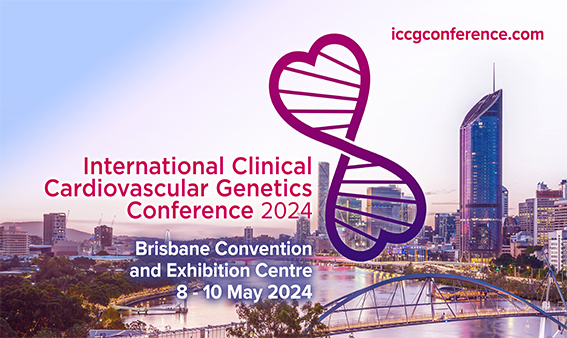
ICCG 2024

If you attended the ICCG 2024, the recordings are now available. To begin the login process to access the Conference presentations, please click here: https://go.csanz.edu.au/Mediasite/Showcase/iccg2024

Instructions on how to log in and access the videos is available here.

FAQs and technical assistance is available here https://events.gigtv.com.au/iccg-conference-2024/

CSANZ members have unlimited access to these presentations.

Access for non-CSANZ members expires Monday 8 July 2024. If you would like to become a CSANZ member, please complete the member application form on the website here.

Heart, Lung and Circulation – latest articles. Hot off the Press

Cardiac Amyloidosis: New Treatments Hold Promise for Early Intervention
A 2024 Australia–New Zealand Expert Consensus Statement on Cardiac Amyloidosis (CA) is now published in Heart, Lung and Circulation. CA is a multi-system condition in which amyloid proteins deposit in multiple organs, including the heart, where this infiltration can lead to symptoms of heart failure, conduction block, and arrhythmias. Endorsed by CSANZ, and co-authored by Bart, Fatkin, Thomas, and others, the Statement outlines recent advances in non-invasive diagnosis, and targeted, disease modifying therapies, including gene editing techniques. The Statement advocates for early referral to a specialist amyloidosis centre for advanced testing and therapy, and active enrolment into clinical trials.
https://www.heartlungcirc.org/article/S1443-9506(24)00123-9/fulltext

Robotic-Assisted PCI: Initial Australian Clinical Experience
As part of the run-in phase for an upcoming randomised clinical trial, Sydney-based researchers have reported their early experience with robotic-assisted percutaneous coronary intervention (R-PCI). All procedures—in 21 patients with a total of 24 lesions—were performed with the CorPath GRX second-generation robot; and, in most cases, were safe and effective, with manual conversion required in four cases. Robotic assistance is designed to allow “millimetre”, and thus more accurate, manipulation via the operator touchscreen; however, some manual inputs at the patient bedside are still necessary, such as when achieving vascular access and performing diagnostic angiography. Among their findings, the researchers observed a short learning curve; with increasing operator and assistant experience, there was less radiation exposure.
https://www.heartlungcirc.org/article/S1443-9506(24)00049-0/fulltext

Before Cardiac Catheterisation: To Fast or Not To Fast?
Although cardiac catheterisation is recognised as the current gold standard test for diagnosing and managing carotid artery disease what is less established is whether fasting is necessary before the procedure. A single-centre prospective cohort study conducted at the Auckland City Hospital, New Zealand (and during the COVID-19 pandemic, no less), has determined that the local policy of no longer fasting patients before the procedure was well-regarded and preferred by the surveyed patients themselves, and seemed safe. The study authors said larger, multicentre studies would be warranted to support an international policy change from fasting to not fasting before cardiac catheterisation.
https://www.heartlungcirc.org/article/S1443-9506(24)00004-0/fulltext

Compiled by Dr Ann Gregory, Commissioning Editor, Heart, Lung and Circulation.

Congratulations to the Editorial Fellows appointed to Heart Lung and Circulation for 2024

Congratulations to the Editorial Fellows appointed to Heart Lung and Circulation for 2024:

Dr Mohammed Al-Omary (NSW), Dr Katherine Bate (NSW), Dr Sinjini Biswas (Vic), Dr Georgia Chaseling (NSW), Dr Hong Chew (NSW), Dr Kenneth Cho (NSW), Dr Jonathan Ciofani (NSW), Dr Avedis Ekmejian (NSW), Dr Hannah Kempton (NSW), Dr Nick Lan (WA), Dr Julee McDonagh (NSW) and Dr Varun Sharma (Vic).

The Heart Lung and Circulation (HLC) Editorial Fellow position is a 12-month honorary appointment to provide aspiring researchers and/or clinician-researchers direct experience working with HLC’s Editorial Boards. The Editorial Fellows will be introduced to a broad range of aspects of academic publishing to encourage ongoing scholarship and involvement with academic scientific journals.

AMENDMENTS TO PBS | 1 MARCH 2024

Please find the latest relevant update to the PBS below:

Chronic heart failure
Dapagliflozin (Forxiga®) (10 mg tablet) is now listed on the PBS for the treatment of chronic heart failure where the patient has a left ventricular ejection fraction of greater than 40%. Prescriptions for treatment are Authority Required (STREAMLINED).

Download FAQs from Services Australia

Services Australia has a broad range of educational resources on the Health Professional Education Resources website, including simulations, podcast and an infographic on the Online PBS Authorities system (click on the link below).

https://hpe.servicesaustralia.gov.au/pharmaceutical-benefits-scheme.html

New 2024-2025 STP support projects applications are now open

Apply for Commonwealth funding for Specialist Training Program (STP) support projects through the Royal Australian College of Physicians (RACP). Final review and approval is made by the Department of Health & Aged Care (DoHAC).

The RACP is accepting new applications for upcoming support projects that provide support for, and clearly benefit, existing STP trainees in settings outside traditional metropolitan teaching hospitals, including regional, rural, remote and private facilities.

Projects that provide cultural safety training in Indigenous healthcare settings will also be considered, and these can be whole of college activities aimed at cultural and/or behavioural change.

Please refer to the RACP website for details on eligibility, how to apply and further information.

Applications must be received on or before Monday, 11 March 2024.

RACP SUBMISSION to TGA Consultation: Medicine Shortages in Australia, challenges and opportunities

The Therapeutic Goods Administration (TGA) has opened an important consultation into medication shortages, challenges and opportunities for reform. Read consultation background and direct link to survey here

The RACP intends on making a submission to the consultation subject to sufficient member feedback. Your related knowledge and advice is therefore requested.

The attached discussion paper outlines the consultation focus questions in full. We recommend that you focus your responses on questions 14-25, being most targeted to specialist practice, however broader responses are welcome.

Please respond to the questions by marking up the attached document (above) and forward to [email protected] by no later than Monday 4 March 2024.
NB: Due to the tight timelines in place, delayed feedback may not be incorporated.

Addressing and reducing medication shortages for you and your patients is a priority for the College and your insight is appreciated in advance.

The Australian National Standards of Care for Childhood-Onset Heart Disease (CoHD)

Announced by the Federal Health Minister last week and published in the Heart, Lung and Circulation, The Australian National Standards of Care for Childhood-Onset Heart Disease can be viewed see full text link below.

https://www.heartlungcirc.org/article/S1443-9506(23)04355-X/fulltext
Further to this read commentary below in an editorial by Prof David Celermajer.

National Standards of Care for Childhood onset Heart Disease (CoHD)—A New Paradigm Whereby Healthcare Professionals, Governments and Consumers Work Together to Optimise Patient Care. https://doi.org/10.1016/j.hlc.2024.01.015

Posts navigation